
Most of us don’t think about our posture until our neck starts hurting or our lower back starts complaining. But the way you hold your body right now — at this desk, with this phone, in this chair — is quietly shaping your spine health for years to come. The good news? You don’t need to overhaul your entire life. A handful of small, consistent changes can make a real difference.
What good posture actually means
Good posture isn’t about standing like a soldier or pulling your shoulders back until they’re sore. It’s about alignment — keeping your head stacked over your shoulders, your shoulders over your hips, and your hips over your knees and ankles. When everything lines up, gravity distributes evenly and your muscles don’t have to work overtime just to keep you upright.
The spine has natural curves in the neck, upper back, and lower back. Good posture preserves those curves instead of flattening or exaggerating them. Think of it like a well-tensioned suspension bridge: slightly curved, balanced, and able to absorb movement without strain. Over time, that balance becomes easier and feels more natural.
The damage of desk life
Desk jobs quietly wreak havoc on the neck. Craning forward to read a monitor shifts the head’s weight from about ten pounds to nearly sixty pounds on the cervical spine. That extra load compresses discs, tightens muscles, and irritates joints. After a few months of forward head posture, you start feeling that dull ache at the base of the skull. It doesn’t go away on its own.
The upper back isn’t immune either. Hunching over a keyboard day after day rounds the shoulders forward and collapses the chest. Over time, the thoracic spine loses its natural kyphosis and becomes rigid. That’s the classic desk hunch, and it doesn’t just look closed off — it restricts breathing, strains the neck, and pulls the lower back into compensation. Your body is one connected system; when one part collapses, the rest adjust in ways that create more problems.
Ergonomic setup at work
- Monitor — Place the top of the screen at or just below eye level, about an arm’s length away. If you use a laptop, consider a stand and external keyboard so you’re not constantly looking down.
- Chair — Choose one with lumbar support that matches the natural curve of your lower back. Your feet should rest flat on the floor, thighs parallel to the ground, and knees slightly lower than hips.
- Desk — Keep the workspace within easy reach so you’re not constantly stretching or twisting. A sit-stand option gives you the freedom to shift positions throughout the day.
- Keyboard and mouse — Keep elbows close to your body at a ninety-degree angle. Wrists should stay neutral, not bent up or down. A split keyboard can help if your shoulders tend to round forward.
Posture habits for everyday life
- Phone — Hold your phone at eye level instead of dropping your head. Even a small prop like a phone stand helps. Take a thirty-second break every fifteen minutes to drop your shoulders and look at something across the room.
- Driving — Sit all the way back against the seat, adjust the headrest to support your head, and keep the steering wheel within easy reach. Avoid hunching forward during long commutes; use cruise control to relax your grip and posture.
- Sleep — A medium-firm mattress and a pillow that supports your neck’s natural curve make a big difference. Side sleepers can tuck a pillow between the knees to keep the hips aligned. Stomach sleeping is the worst position for the spine, so try to train yourself to another position.
Stretches that actually help
- Chin tucks — Gently draw your chin straight back without tilting your head up or down. This resets forward head posture. Hold for five seconds and repeat ten times.
- Doorway chest openers — Place your forearms on a doorframe and step through slowly. You’ll feel a stretch across the chest and front shoulders. Hold for twenty to thirty seconds on each side.
- Cat-cow stretches — On all fours, alternate between arching your back up (cat) and letting it drop (cow). This mobilizes the entire spine and releases tension after hours of sitting.
- Thoracic extensions — Sit in a chair with a firm back, clasp your hands behind your head, and gently arch back over the chair edge. This opens up the upper back and reverses the desk hunch.
When posture problems need help
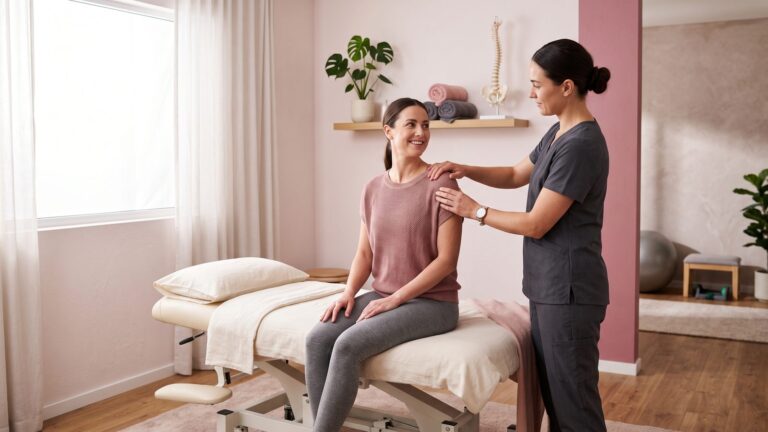
Self-care and ergonomic fixes work well for mild, recent discomfort. But if you’ve had recurring pain for weeks or months, it’s time to bring in a professional. A chiropractor can assess spinal alignment, identify restrictions in joint movement, and perform gentle adjustments that restore normal motion. Many patients feel measurable improvement within a few visits, especially when combined with posture training at home.
Physiotherapy adds another layer by targeting the muscles that support your spine. A physiotherapist can evaluate weak core muscles, tight hip flexors, or uneven strength patterns and build a tailored exercise program. The goal isn’t just pain relief — it’s building a spine that can handle daily life without breaking down. Chiropractic and physiotherapy often work best together.
When to book a visit
Don’t wait until the pain is constant or severe. If your discomfort lasts more than a week, keeps coming back, or is accompanied by numbness or tingling, get it checked. Dr. Shahb Arani’s clinic offers comprehensive posture assessment, chiropractic care, and physiotherapy designed to protect your spine long term. Book a visit and start feeling better today.
Related reading
Ready to take the next step?
Call the clinic or send us a message on Instagram for a personalised assessment.